Workshop 9 : Quaker Theology PART 2 - 03/08/2026
Karen Tibbles
Instructor
Early Quaker history & theology (continued)
Quakertown Monthly Meeting : March 2026
Belief from what you have been told versus experience
Individual mysticism versus group experience
Waiting on the Lord
Progress of religion is a progress of subtraction (Howard Brinton, Friends for 350 years, page 12-13)
Catholic: used symbols
Puritanism: Subtracted the Pope, the Mass, images and five of the seven sacraments
Presbyterianism: Subtracted the Bishops, substituted the elders
Independent: decentralized church government, more democratic procedure
Baptists: Subtracted infant baptism
Quakerism: Subtracted all ritual, all programmed arrangements, professional ministers.
Heaven and Hell and the second coming
Many mentions of heaven and hell in early Quaker writing. Most Quakers came into the religion from Puritanism. But a major Quaker scholar suggests an evolution of thought that derived from the belief that there is God within.
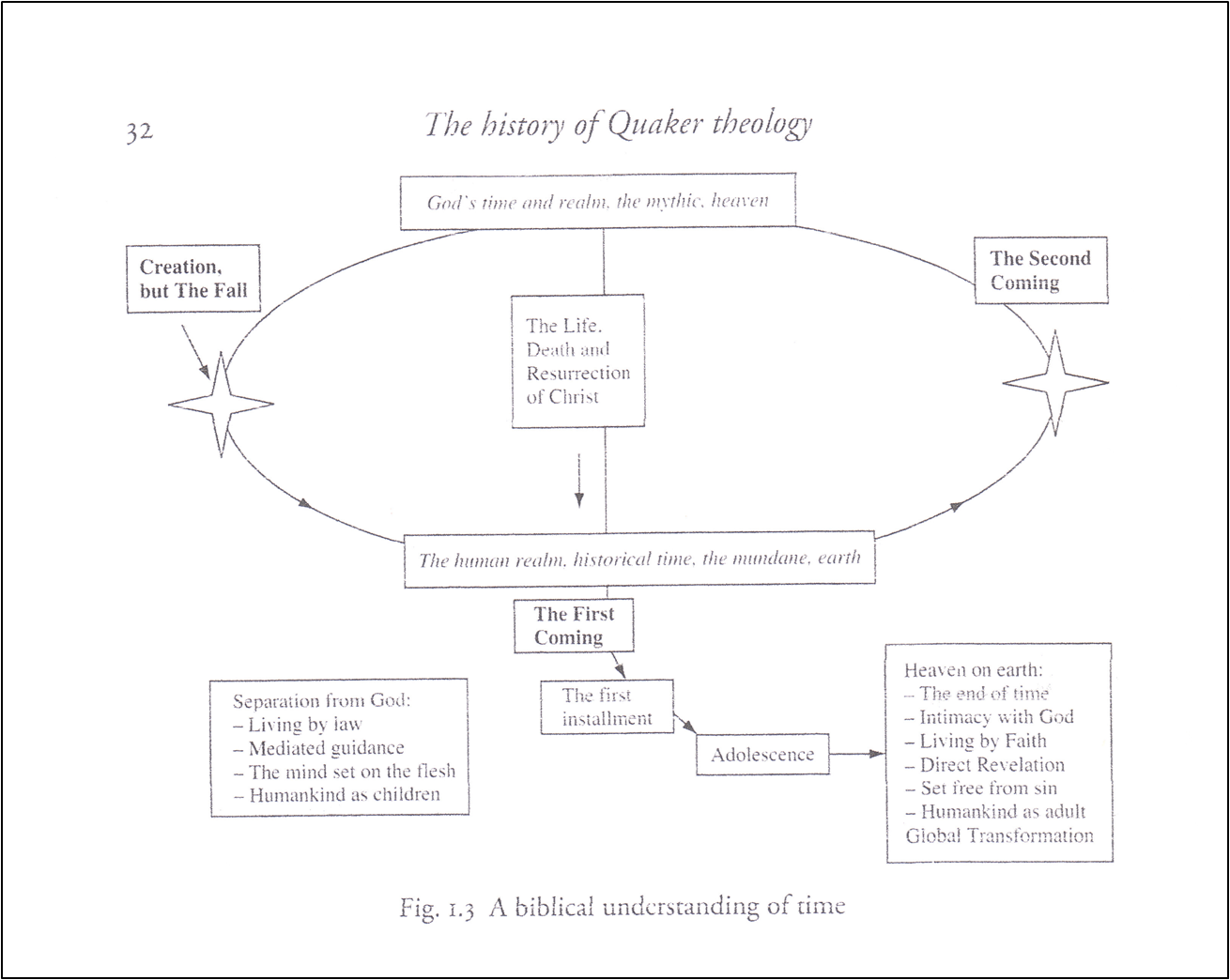
Paul’s view of the fall and the second coming (Ben Pink Dandelion, An Introduction to Quakerism, p. 31-32)
1. Humanity develops in intimacy with God
2. Adam and Eve disobey, humanity separated from God
3. God’s guidance is mediated by the law
4. Childlike
5. Humanity in constant struggle with temptation
6. Human realm (time) separated from God’s realm (heaven)
7. Jesus’s life, death and resurrection bring together the two realms
8. Paul has been given authority to pass on what has been revealed to him
9. A time will come when all will meet Christ, age of the law will have passed
10. All will have access to faith’s “inner voice”
1 Corinthians 15:1-8; Romans 8: 1-9, 14-17
Early Quakers believed they were experiencing the second coming. “They had experienced the risen Christ – Christ has come – and were thus a vanguard for the global transformation which is to follow.” (Dandelion, P 33) Thus, they believed that they were bringing about Heaven on earth with the Christ that had already come a second time.
Valiant 60
Some of the valiant 60 went to Constantinople to address the Sultan. Mary Fisher had a pleasant meeting with him in May or June of 1657. One of her party, John Luffe, subsequently went to Rome and had an audience with the Pope and called him the Antichrist! He claimed to the Pope that “every day is a Sabbath where we can serve God” The pope asked him “was nothing to be done for remembrance's sake of our blessed Lord? Luffe replied, …I have Christ about me and in me and therefore cannot choose to remember him continuously” (Dandelion, p. 30)
Others went to America (where they were hanged on Boston Commons, were imprisoned and executed by the Inquisition in Spain and Italy, and whose message bore fruit in Germany and Holland.
Sacraments
The sacraments of the Christian religion (baptism, communion, last rites) are intended to be symbols of spirituality. But Quakers reject the need for symbols, they want an emphasis on the spiritual experience, the reality, not the symbols.
“The inward communion supper is the marriage supper of the blood of the Lamb…. Quakers were involved in the Lamb’s War, the spiritual crusade to establish the kingdom of heaven and earth.” Dandelion 36
Instead, they focused on the “sacrament of life”: the realization “that God is continuous in and around us.” Brinton, p. 66
Silent worship as practiced by Quakers is an opportunity to practice the continuous indwelling presence of God. “There must be withdrawal to the internal source of power and then a return with power.” Brinton p. 77
“There is nothing in Quaker theory that would categorically exclude such rites as baptism and communion, provided these were, when experienced, genuine outward expressions of real and holy inward states.” Brinton, p85
Image from Dandelion page 32